


09 Mar The Core Principles of Wing Tsun KungFu
Simplicity, Efficiency and Practical Application – The Core of Wing Tsun Theory
According to legend, the Wing Tsun system was created in the 16th century by the Buddhist nun Ng Mui, who passed her knowledge on to a young woman named Yim Wing Tsun. Her name, translated from Chinese, means “Beautiful Spring”, symbolising freshness, grace and new beginnings.
What makes a martial art developed by a woman different from those created by men? Wing Tsun demonstrates that softness and yielding can overcome brute strength. Its close-range striking techniques are designed to be more effective in real-life self-defence situations than long-range kicking techniques.
During a Wing Tsun training session, you will not see students stretching in preparation for high kicks, nor will you see them practising the traditional “block-and-punch” combinations found in many other martial arts. Instead, your attention is likely to be drawn to the distinctive partner drills known as Chi Sau (translated from Chinese as “Sticky Hands”).
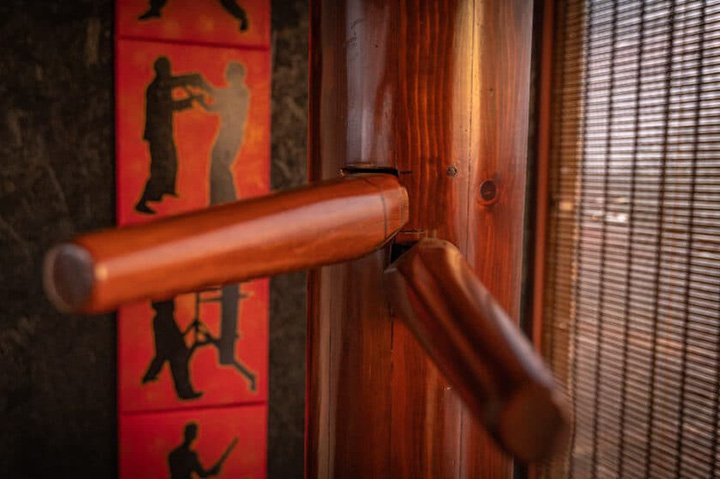
Practitioners who have faced experienced Wing Tsun instructors often describe Chi Sau as one of the system’s most effective and challenging training methods. In a Wing Tsun school, you will also notice the iconic wooden dummy (Muk Yan Jong) and, in some schools, metal training dummies, which play an essential role in developing precision, structure, timing and technique.
The Five Core Principles of Wing Tsun Kung Fu
The essence of Wing Tsun lies in five fundamental principles that help practitioners understand the philosophy and effectiveness of this Chinese martial art. These principles reflect the natural laws of movement, adaptability, and the continuous transition from one state to another.
1. The Centreline Principle
The Centreline Principle is the foundation of Wing Tsun and consists of two key elements.
Protection
The hands are held slightly bent at the elbows and positioned forward along the centreline of the body. The elbows naturally protect the torso from both sides, eliminating the need for traditional blocking techniques.
Redirection
Rather than meeting force with force, defensive actions are designed to redirect an opponent’s attack away from the centreline using minimal strength and energy.
2. Attacking the Opponent’s Centreline
This principle can also be found in several traditional Asian martial arts. Although a straight punch may appear simple, executing it correctly requires precision, proper structure and body alignment.
The objective is to deliver the full power and body weight through the strike while maintaining balance, efficiency and control.
3. The Straight-Line Principle
The shortest distance between two points is a straight line. For this reason, Wing Tsun favours direct, efficient movements that reach the target as quickly as possible.
Nearly every Wing Tsun technique follows this principle.
As Grandmaster Si-Jo Leung Ting, founder of the International Wing Tsun Association, explains:
“Small circles are more efficient. We try to transform circles into straight lines.”
While straight-line attacks are fundamental, curved strikes are also used when necessary to bypass an opponent’s defence and create new attacking angles.
4. The Spring Principle
Wing Tsun distinguishes between rigid force and elastic force.
Rigid force resembles a strong oak tree—it may resist great pressure, but it can eventually bend or break.
Elastic force, however, behaves like a spring. It absorbs energy when compressed and releases it explosively when the opportunity arises.
A Wing Tsun practitioner’s arms function in exactly this way—constantly compressing, storing energy and driving forward.
The principle can be summarised simply:
“Compress like a spring when under attack. Never retreat because of your opponent’s movement. Strike the moment an opening appears.”
When an opponent attacks, the Wing Tsun practitioner yields slightly rather than resisting directly. Like a compressed spring, energy is stored until the attacker creates an opening by withdrawing or changing position. At that precise moment, the practitioner’s limbs naturally follow and counterattack.
This illustrates one of Wing Tsun’s core ideas: softness can overcome hardness.
5. Simultaneous Attack and Defence
One of Wing Tsun’s defining characteristics is the ability to defend and attack at the same time.
Rather than blocking first and striking afterwards, a Wing Tsun practitioner redirects the incoming attack away from the centreline while simultaneously launching a counterattack.
The effectiveness of this principle depends not on memorising techniques, but on developing tactile sensitivity.
Through Chi Sau (Sticky Hands) training, practitioners develop:
- Sensitivity to an opponent’s movements
- Flexibility and relaxation in the joints
- Efficient use of energy
- Automatic reactions essential in real combat situations
Even a brief moment of conscious hesitation slows reaction time. Relying solely on vision means first identifying an opening, then deciding how to respond, and only afterwards taking action. In a real confrontation, this process is often too slow.
By internalising these principles through consistent practice, Wing Tsun practitioners develop instinctive responses that seamlessly combine defence and attack into one continuous, efficient movement.


